

PioNext Mini dental applications include temporary crowns and bridges, diagnostic and digital wax-up models, intraoral mock-ups, occlusal splints, surgical guides, and separately printed flexible partial-denture bases and temporary teeth. Model options include Ortho Model Resin, Ortho Model 2.0 Resin and Removable Die Model Resin; restorations and appliances use their corresponding dental materials and finishing processes.
PioNext Mini combines printing and curing in a device measuring 200 × 170 × 241 mm, with a compact footprint that fits comfortably on a standard A4 sheet. The small footprint suits clinics with limited workspace. Printing close to the treatment room helps the team supply selected models and appliances sooner, reduce collection delays and organize appointments around local production. Where fabrication or delivery has limited a service, this can also release capacity for additional appointments.
Start With the Outputs Your Clinic Needs
A useful way to answer “what can a dental 3D printer make?” is to start with the object the team needs at the next consultation or fitting.
|
Need in the appointment |
Potential physical output |
Value to the clinic and patient |
|
Provide a presentable interim tooth or teeth |
A temporary crown or bridge in Temporary Restoration Resin |
Manufacturing can take place locally while the practice works toward the planned provisional fitting |
|
Explain the current dentition or proposed tooth form |
A diagnostic or proposal model in a supported model resin, such as Ortho Model 2.0 Resin |
The patient and dentist can examine a tangible reference together |
|
Preview an aesthetic change in the mouth |
A mock-up made through the application-specific material workflow |
Tooth shape and the patient's preferences can be discussed during a physical preview |
|
Transfer planned implant guidance into a physical appliance |
A surgical guide in Surgical Guide Resin, with any required sleeves |
Brings guide fabrication into the clinic's production workflow |
|
Supply a prescribed occlusal appliance |
A splint made with a matched splint resin |
Local production connects the dental CAD design with fitting and patient feedback |
|
Provide a provisional removable partial denture |
A base in Flexible Denture Base Resin and temporary teeth in Temporary Restoration Resin, printed separately |
The practice can produce the components close to the team completing assembly and fitting |
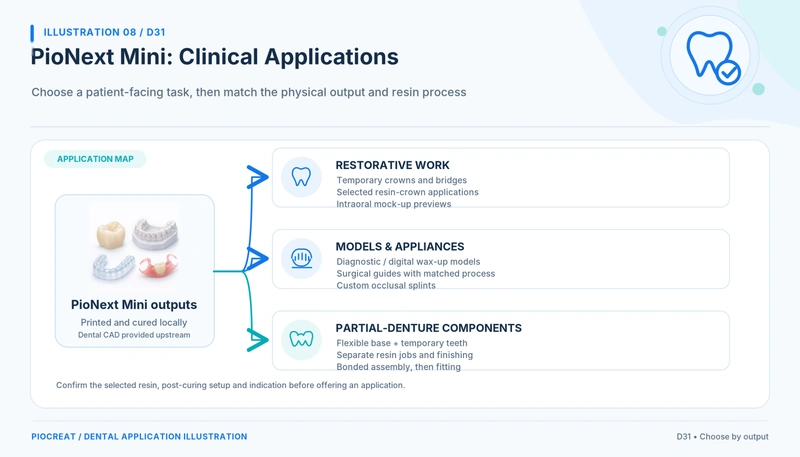
Connect the output to the appointment: a provisional protects a prepared tooth, a mock-up previews a proposed smile, and a surgical guide carries the planned guide geometry into a physical appliance. This application map helps the practice decide which objects it currently waits for and which it would benefit from producing locally.
Restorative Applications With the Right Resin
Our dental resin range gives a practice material choices for different restorative tasks. Temporary Restoration Resin serves temporary crown and bridge applications. Ceramic Crown Resin provides a ceramic-filled restorative material for its specified crown and related restoration uses. Crown & Bridge Resin adds another restorative material option, while Surgical Guide Resin serves implant-guide fabrication. For a guide, match the selected resin, any sleeves, post-curing and disinfection or sterilization method to the intended guide system. These materials serve different clinical objects and use their own processing profiles.
For the ceramic-filled crown application, our ceramic-crown workflow connects PioNext Mini printing with the material-specific cleaning and finishing route.
Mock-ups serve another purpose: they give the patient a preview of a proposed change. The discussion centers on tooth length, contour and the appearance of the smile before the final restorative work. A physical preview is particularly useful when a patient can describe a preference more easily by pointing to a feature than by discussing a screen image.
Models and Splints for Daily Practice
Print a scan-derived model or digital wax-up to bring the treatment proposal onto the consultation desk. The dentist can show the patient a worn edge, a proposed crown shape or the region being restored, then compare current and proposed forms side by side. A physical reference makes the explanation easier to follow without navigating dental software.
Ortho Model Resin and Ortho Model 2.0 Resin provide model-material options within the PioNext Mini portfolio. Removable Die Model Resin supports working models with removable dies, giving the technician access to the preparation finish line when reviewing a restoration's marginal adaptation. Select the model type according to what the consultation or restorative task needs to show.
An occlusal splint adds a patient-worn appliance to this application range. The PioNext Mini resin parameter reference includes soft and hard splint entries. If you are unfamiliar with material profiles, our team can help match the exact resin, printing and post-curing setup; a third-party resin also needs its manufacturer's confirmation. At fitting, the dentist checks seating, retention and occlusal contacts with the patient.
Denture Applications and Separate Components
We offer Flexible Denture Base Resin for the flexible base and Temporary Restoration Resin for the temporary tooth units in a provisional partial denture. Our PioNext Mini flexible-denture workflow prints these components in separate jobs, then cleans, dries, cures, finishes and bonds them into an assembly.
The flexible base supplies the gum-colored supporting structure; the temporary teeth supply the visible tooth forms and occlusal surfaces. Their material and assembly details are covered in the linked workflow.
Local production lets the patient see the assembled provisional partial denture in the clinic sooner: the replacement teeth within the smile, the gum-colored base and its relationship to the remaining teeth. At fitting, the dentist can identify pressure areas and check retention and occlusion using the actual assembly. The clinic can address a specific design change through the saved base or tooth files.
Choose One Application to Evaluate First
These applications can add different services to a PioNext Mini practice. Begin with the one that addresses the most frequent patient need or the greatest current delivery delay, then run representative cases and calculate the actual benefit.
- For an interim-restoration service, assess a completed temporary crown or bridge in the selected resin, including the patient's time to fitting and the cost of finishing it.
- For consultation models, choose a case where a physical comparison helps explain tooth shape or a proposed change.
- For splints, assess the matched material workflow using the finished appliance and fitting feedback.
- For a provisional partial denture, assess the assembled base and teeth, with attention to appearance, seating and surface finish.
Compare the selected service with the practice's current route using turnaround, hands-on time, visits and cost per completed item. Include design, materials, finishing, equipment allocation and remakes in that cost. Tell our team which service you want to introduce for help with its PioNext Mini material setup and application resources.