

A patient waiting for a custom occlusal splint is waiting for a device they can actually wear: one that seats securely, feels comfortable and fits the dentist's treatment plan. Producing it inside the practice can shorten the journey between a digital scan and that first fitting.
PioNext Mini combines printing and curing in a compact dental system, helping clinics manufacture custom appliances on site. For a practice introducing 3D printed occlusal splints, the workflow connects scanning, dental CAD design, local production and fitting, so the patient can try the appliance and discuss comfort directly with the clinical team.
Where Printed Splints Fit in a Dental Practice
Occlusal splints are custom appliances that cover the teeth and provide a designed biting surface. Depending on the clinical prescription, they can be used to help protect teeth from wear or as part of managing particular bite-related problems. They are a recurring service for practices treating patients with clenching, grinding or restorative wear concerns.
In-house manufacturing is useful when a practice wants to make these appliances available sooner. A clinic that currently sends impressions or scans to a lab can continue using the lab for dental CAD design, receive the appliance file digitally, and manufacture it locally. A practice with an existing dental design team can keep both stages on site.
The patient-facing change is the time to the first fitting. Local production removes physical shipment of the appliance and allows the dentist to discuss fit and comfort with the patient soon after fabrication. For patients who travel a long way to the clinic, avoiding a separate collection visit can be a meaningful convenience.
Our same-day digital splint case provides a practical example: a custom appliance produced with PioNext Mini and PioNext Splint Resin and delivered during one appointment.
Choosing a Compatible Splint Resin for PioNext Mini
The material affects flexibility, clarity, polishing and the feel of insertion and removal. A clinician may prefer a more rigid or a more flexible formulation for a particular prescribed appliance. The manufacturing workflow must match that exact material.
Our PioNext Mini resin parameter reference includes third-party Keystone entries named “Keystone - Splint soft” and “Keystone - Splint hard.” Our chairside case features the PioCreat material identified there as PioNext Splint Resin. Compare these material options by their intended appliance use and complete processing route.
Confirm compatibility with our team and, for a third-party resin, its manufacturer before adopting a formulation. Confirm the resin's exact product and version, intended appliance use, PioNext Mini profile, cleaning method and specified post-curing equipment and cycle. Include whether PioNext Mini's integrated curing unit is supported for that resin or whether another specified curing system is needed.
For sample comparison, examine fully processed appliances. Compare the clarity after polishing, the finish at the edges, and the feel of seating and removal in the intended clinical evaluation. These characteristics are more informative than a bottle described simply as “clear dental resin.”
From Professional Design to a Finished Splint
The workflow offers three linked benefits: rapid custom fabrication, a compact local production setup, and an early opportunity for the patient to try the appliance and describe the experience.
First, turn the scan into a patient-specific appliance. Capture the upper and lower dentition and bite, then use dental CAD or a laboratory design service to create the splint. The design defines the coverage, internal fit and biting surface needed for the prescribed application. The resulting file goes into PioNext BOX for print preparation.
Next, manufacture it close to the treatment room. Select the confirmed PioNext Mini material profile, orient the splint and prepare its supports. For reference, the splint in our same-day chairside case was printed in approximately 20 minutes. The selected resin, layer setting and prepared geometry determine the estimate for a new job.
After washing, the operator dries the appliance as directed by the resin's instructions before post-curing. Support removal, finishing and polishing follow the sequence specified for that material. PioNext Mini combines the printing and curing functions in a 200 × 170 × 241 mm machine, making the local production setup compact. The resin-specific cleaning step fits between those functions.
Finally, bring the appliance to the patient for fitting and feedback. The dentist checks seating, retention and occlusal contacts and completes any appropriate finishing or adjustment. The patient can describe pressure areas, difficulty removing the splint or a bulky edge while the clinical team has the appliance and digital design available.
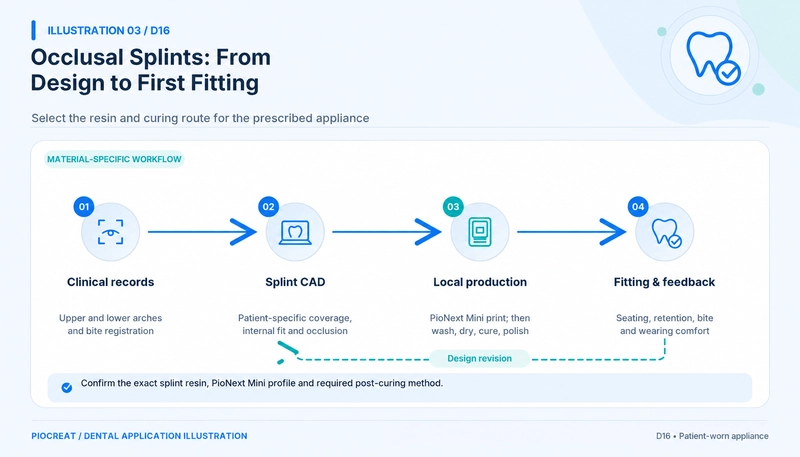
This short feedback cycle helps the clinic address the actual wearing experience. A patient can practice inserting and removing the appliance, ask about cleaning, and understand the prescribed wearing schedule before leaving. Where a design change is needed, the digital file provides a focused starting point for the next version.
Questions About Fit, Clarity and Comfort
A useful sample assessment looks at the appliance as the patient will receive it: cleaned, cured, finished and polished.
|
Feature |
What to assess |
Why the patient cares |
|
Seating and retention |
Complete seating, stability and ease of removal during the dentist's assessment |
A secure appliance that the patient can handle |
|
Internal surface and edges |
Smooth surfaces, rounded finished edges and well-finished support areas |
Less rubbing and a more comfortable feel |
|
Occlusal surface |
The intended contacts and room for any clinical adjustment |
A biting surface that fits the prescribed design |
|
Clarity and finish |
Appearance after the full processing and polishing sequence |
A clean-looking appliance that is pleasant to wear |
|
Shape and bulk |
Coverage and contour in relation to the patient's mouth |
Comfort when closing the lips and speaking |
Ask the patient specific questions at delivery: “Is one area pressing more than the others?” and “Can you remove it as shown?” These observations help locate the part of the appliance that needs attention.
At follow-up, the dentist can review the wearing experience alongside the surface condition, retention and bite. A stored digital design is also useful if the patient loses or damages the appliance: after checking that the current dentition still matches, the team can manufacture a replacement without rebuilding the entire design from the beginning.
Deciding Whether to Bring Splints In-House
A clinic gains most when the service combines recurring demand, a workable design route and a production process the team can complete consistently. Compare the current lab-made service with the same type of finished, fitted appliance made locally.
The commercial comparison has several parts:
- Fabrication cost: resin and supports, cleaning consumables, finishing tools and any repeat print.
- Professional and staff time: design fees, operator work and fitting or adjustment time.
- Logistics: shipping charges and the elapsed time before the appliance reaches the clinic.
- Equipment use: the allocated cost of the printer, processing equipment and maintenance over the expected workload.
- Patient convenience: time from scan to first wear and the number of visits needed for delivery.
Keeping dental CAD with a laboratory can make the first stage of adoption easier: the practice pays for specialist design while taking control of fabrication. As volume grows, the clinic can compare that arrangement with performing selected designs internally.
For a PioNext Mini demonstration, follow a representative splint from scan to delivery. Measure total turnaround, hands-on production time, fitting adjustments and cost per completed appliance. Combine those measurements with the patient's comments about comfort and convenience to see the value of the service in everyday use.
Discuss a PioNext Mini splint application with our team, including the desired material and expected case volume. The PioNext Mini system overview provides the equipment specifications for planning the local setup.