

For a patient missing some teeth, the appearance and feel of a removable partial denture depend on several parts working together. The base sits around the missing-tooth area, the retention features relate to the remaining teeth, and the replacement teeth provide the visible tooth shape and biting surfaces.
3D printed flexible partial dentures bring these components into a digital manufacturing route. Our PioNext Mini workflow demonstrates a provisional application in which the flexible base and temporary teeth are printed separately, then finished and bonded. Understanding their separate roles helps a practice assess the service it can provide with local production.
Why a Flexible Partial Denture Is a Distinct Application
A partial denture replaces teeth within an arch that still has natural teeth. Its design has to work with those teeth and the surrounding tissues. A complete denture replaces an entire dentition in an edentulous arch and presents a different support and retention task.
In a flexible partial design, the base and its designed retention features can offer a gum-colored alternative to visible metal components. For patients discussing a provisional replacement in a visible area, the appearance of that base and the position of the replacement teeth can matter as much as the shape of the teeth themselves.
Our PioNext Mini flexible-denture application includes temporary aesthetic replacement and transitional partial-denture uses. The dentist selects the appropriate provisional approach for the patient's remaining teeth, tissues and restorative plan.
A clinic and laboratory can develop a patient-specific partial design, produce its components locally and assess the assembled provisional at fitting.
What Our PioNext Mini Workflow Demonstrates
The workflow begins with the patient's dental records and a denture design in dental CAD. That design supplies separate geometry for the base and temporary teeth.
PioNext Mini produces the base using Flexible Denture Base Resin. The tooth units are produced in a separate job using Temporary Restoration Resin. PioNext BOX prepares each job with its corresponding printer and material profile.
The two sets of components then follow their respective cleaning, curing and finishing procedures. They are joined through the material-specific bonding process and finished as an assembled partial denture. Our existing workflow provides the detailed operating reference for these stages.
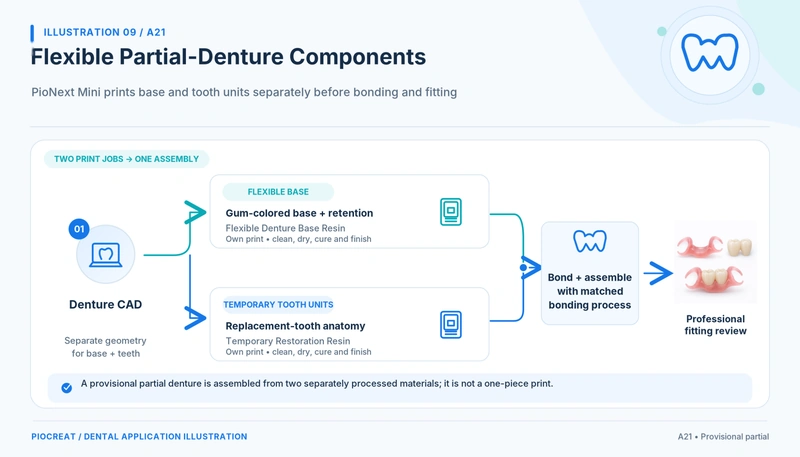
Printing the base separately lets the team finish its tissue-facing surface, borders and retention features before joining it to the temporary teeth. The patient receives a gum-colored provisional for the missing-tooth space, while the clinic can retain separate digital files for base refinements and tooth-shape changes. This is particularly relevant during an interim replacement while the patient waits for the next restorative stage.
The patient evaluates the assembled result: whether its appearance meets the intended interim need, how the base feels, and how it seats around the remaining teeth. Those observations give the dentist and technician a concrete basis for any refinement.
Base Resin and Tooth Resin Have Different Jobs
The base and teeth need different material behavior because they perform different tasks.
|
Component |
Material used in our PioNext Mini example |
Role in the assembled provisional |
|
Flexible base and designed retention features |
Flexible Denture Base Resin |
Forms the gum-colored supporting structure and the flexible elements of the partial design |
|
Temporary tooth units |
Temporary Restoration Resin |
Provides the replacement tooth anatomy, visible shade and biting surfaces for the provisional application |
|
Connection between base and teeth |
The bonding material and process specified for the selected combination |
Holds the components together as a finished assembly |
Flexibility is relevant to the base's role; it does not describe everything the patient needs from the appliance. The tooth units require their own shape, finish and material selection. The interface between them is equally important because a smooth, complete connection contributes to the quality of the assembled result.
Our dental resin portfolio lists Flexible Denture Base Resin for removable partial-denture bases and Temporary Restoration Resin for temporary restorative work. In this application, the temporary tooth units are the replacement teeth of the provisional partial denture.
During a sample review, examine the complete assembly from the visible, tissue-facing and connection sides. Check for unfinished support marks, rough edges, visible gaps at the base-tooth junction and shade differences that affect the intended appearance. This reveals the finishing work needed to supply the service in everyday practice.
Questions for a Clinic-Lab Application Trial
Choose a representative provisional partial-denture design that reflects the service the clinic wants to introduce. The evaluation should follow the component prints through assembly and professional fitting, so the practice can understand the finished result and the work required.
The most useful questions concern the patient and the completed partial:
- How does it look when the patient smiles? Assess the replacement tooth form and shade, the visible base and the appearance of the retention features.
- How does the assembled base seat? The dentist can assess its relationship to the remaining teeth and supporting tissues during fitting.
- How do the finished surfaces feel? Ask the patient to identify roughness, bulky areas or places that feel uncomfortable so the team can examine the corresponding feature.
- Does the assembly remain sound during the intended handling and fitting checks? Review the base-tooth connection and any adjustments with the laboratory.
- What is the complete production time? Include both print jobs, material changeover, cleaning, curing, bonding and finishing, followed by fitting.
- What does a completed provisional cost to make? Include both materials, consumables, design work and hands-on finishing and assembly.
This evaluation links flexible partial denture printing to an actual clinic service. It shows where local manufacturing helps and which parts of the work the practice prefers to retain with its laboratory.
Choose a Supported Material Combination
The base, temporary teeth and bonding route work as a material combination. In our PioNext Mini reference workflow, the base and tooth jobs both use a 0.1 mm layer thickness, with separate resin profiles. Their post-curing cycles are different:
|
Stage |
Material in the reference workflow |
PioNext Mini built-in curing setting |
|
Flexible base post-cure |
Flexible Denture Base Resin |
PWM 50% for 5 minutes |
|
Temporary teeth post-cure |
Temporary Restoration Resin |
PWM 30% for 1 minute |
|
Bonding cure |
The specified bonding route using Flexible Denture Base Resin |
PWM 30% for 1 minute |
These are reference settings for the named PioNext materials and the PioNext Mini curing unit. Match the current product version and processing instructions before using them; a third-party material needs its own confirmed process.
Wash the two components separately, dry them before post-curing and finish their support areas. During assembly, verify that the temporary teeth seat completely in the base, remove excess bonding material from the junction and complete the specified bonding cure. This preserves the intended tooth position and gives the patient a smoother transition between the base and teeth.
Base thickness, clasp dimensions and the amount of material removed during finishing affect the flexibility of the finished partial. More grinding changes the designed cross-section; it is therefore important to preserve the planned retention features while smoothing their surfaces. The base-tooth junction needs equal attention: check for complete seating, visible gaps and exposed bonding residue.
Our complete flexible-denture workflow provides the operating sequence. Contact our team with your intended provisional partial design for guidance on the PioNext Mini base, tooth and bonding setup.