

A denture try-in lets the patient see the proposed teeth in their own smile and describe how the trial feels while speaking. The dentist can assess the tooth setup, seating and bite relationship before the laboratory finishes the final base and teeth.
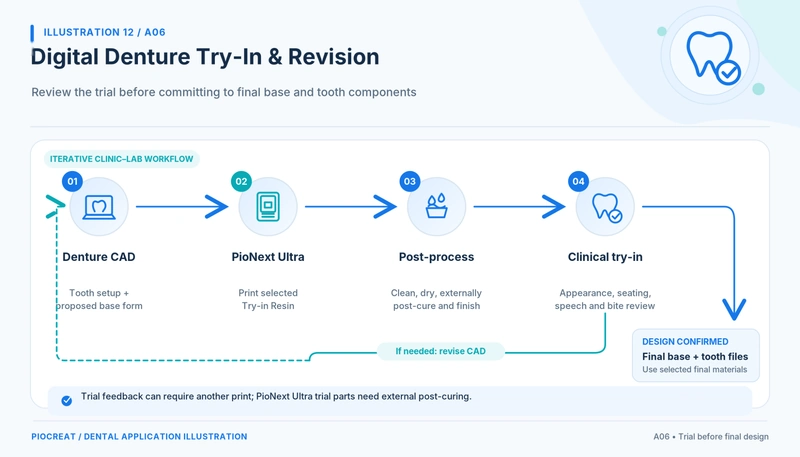
A 3D printed denture try-in turns the dental CAD setup into that physical reference before the final base and teeth are manufactured. With PioNext Ultra, the laboratory can prepare a trial-production workflow around the selected denture geometry and matched material process. The finished trial gives the dentist and patient a physical tooth setup to assess before final production.
Why a Try-In Is Different From a Final Denture
A try-in represents the proposed denture for a fitting and design review. Its purpose is to help the dentist, patient and technician decide what should be retained or changed before final production.
The trial can present tooth arrangement, visible tooth length, the broad base form and the relationship of the proposed teeth to the patient's smile. It gives the dentist a physical object for the fitting assessment and gives the patient something specific to respond to.
The final denture serves a different stage: daily use after its base, teeth and assembly have been produced in the selected final materials. The trial's value is the opportunity to identify a desired change while the design remains straightforward to revise in dental CAD.
This is particularly useful for appearance preferences. A patient may find it difficult to choose a tooth shape from a screen, yet readily identify that the front teeth look too prominent when viewing a trial in a mirror. That feedback can influence the final arrangement before the lab invests in finished base and tooth production.
What the Professional Team Wants to Review
A useful digital denture try-in brings professional assessment and the patient's own experience into the same consultation.
|
Review area |
What the trial helps the team examine |
Patient-facing value |
|
Tooth arrangement and visible length |
The position and appearance of the proposed teeth in the smile |
The patient can identify the appearance they prefer using a physical preview |
|
Lip support and overall appearance |
How the proposed form presents with the patient's lips and facial expression |
The discussion concerns the patient's own smile and profile |
|
Speech and available tongue space |
The dentist's phonetic assessment and the patient's response while speaking |
The patient can describe unfamiliar or crowded sensations during the review |
|
Seating and the bite relationship |
The clinical checks relevant to the trial and the records used to design it |
Fitting feedback can inform the denture design before the final parts are made |
|
Final tooth color |
The selected shade guide or suitable final-material sample, alongside the trial |
The patient can take part in the shade choice using an appropriate color reference |
The dentist can translate broad comments into features the technician can revise. “I want a softer smile” becomes more useful when the patient and clinician identify the tooth form, visible length or arrangement that creates that impression.
When the trial material and final tooth material have different appearances, discuss the final shade with a shade guide or finished material sample. The trial then supports the shape and arrangement conversation, while the patient also has a relevant reference for color.
Where PioNext Ultra Printing Fits in the Trial Stage
PioNext Ultra occupies the manufacturing step between the dental CAD setup and the finished trial. Its 211.68 × 118.37 × 100 mm build volume provides space for full-arch trial forms and, where the prepared geometry permits, multiple trials in the same resin job. The laboratory can group compatible orders instead of preparing a separate machine run for every arch.
Our dental resin range includes Try-in Resin for denture try-ins. For this PioNext Ultra application, our team first confirms the exact resin and print profile together with the required cleaning and external curing route. The sample used for the application evaluation should pass through that same finishing process.
PioNext BOX prepares the dental CAD file for printing. The printed trial then goes through cleaning, drying, external post-curing and surface finishing before the fitting review. The lab's evaluation can examine whether the printed form preserves the tooth arrangement, base outline and accessible details needed for the consultation.
PioNext Ultra's temperature-controlled chamber operates at 25–35°C, supporting consistent resin conditions across a laboratory job. Dual linear guide rails and a ball screw support stable Z-axis movement during layer formation. Together with the build area, these features are relevant when the lab repeatedly produces full-arch trial forms and needs a consistent setup for multiple clinic orders. Cleaning and external curing complete the production line.
Turning Try-In Feedback Into a Revised Denture Design
The trial should reveal which part of the proposed denture needs to change. At the try-in, relate the patient's response to the tooth setup and base form:
- Too much or too little visible anterior tooth: review incisal length and vertical tooth position in the smile photographs before changing the arrangement in dental CAD.
- Excessive fullness around the upper lip: examine the anterior tooth position and labial flange contour together; each can affect the profile the patient sees.
- Difficulty with particular sounds or restricted tongue space: record the dentist's phonetic findings and the area of perceived bulk so the technician can review the relevant tooth and palatal contours.
- An uneven bite or a trial that does not seat as intended: return the seating and jaw-relation findings to the technician before refining the occlusal setup.
The revised design should retain the features that worked and change the identified area. If the modification affects visible tooth position, lip support or the bite relationship, another physical trial can show the revised arrangement before the final base and teeth are made.
For PioNext Ultra production, orientation affects both supports and the number of layers. As a planning example, a prepared trial 20 mm high contains about 200 layers at 0.1 mm or 400 layers at 0.05 mm, where those layer settings are supported by the selected material profile. This makes the effect of changing orientation or layer thickness concrete. Use the matched job's estimate in PioNext BOX to reserve the printing slot, then add cleaning, drying, external curing and finishing to schedule the dispatch or fitting.
When several revised trials use the same material profile, the laboratory can place them in one build if their geometry permits. This is where PioNext Ultra's platform area contributes to the revision service: several clinics' trial orders can share a production run, while each finished trial remains linked to its own revised denture file.
Connect the Try-In to Final Base Production
After the try-in changes have been incorporated, the final design can bring together the selected tooth arrangement, the patient's appearance preferences and the dentist's fitting and functional findings. The laboratory carries that revised setup into the final base and tooth designs.
The chosen final materials determine the manufacturing and assembly details. Our Denture Base Resin is an option to discuss for the final base; the tooth material and bonding system are selected with it for the intended denture. The trial geometry provides the design reference, while the final component files account for the selected manufacturing route.
Save the final tooth setup, base design, shade selection and the revised features together. This gives the clinic and laboratory a clear reference for the finished denture and for later design work related to that case.
Contact our team for denture-application resources or share a representative denture design for guidance on PioNext Ultra print preparation, material selection and the points to check during post-processing. The aim is a trial that helps the patient and dentist settle the features that matter before the lab manufactures the final components.