

A dental clinic can manufacture closer to its patients and keep the design expertise of its laboratory. The lab develops the restoration or appliance in dental CAD; the clinic uses PioNext Mini to produce the physical result and discuss it with the patient. Digital files travel between the partners while selected models, previews and appliances are made on site.
Dental lab design for chairside 3D printing supports closer clinic and dental lab collaboration. A technician can respond to a smile-design question, the clinic can print the revised preview locally, and the patient can give feedback on a tangible result. The potential benefits include shorter physical delivery times, fewer shipping steps and a more direct path from specialist design to chairside use.
Why Clinics May Keep Design With a Lab
Dental CAD design involves much more than changing the size of a scanned model. For restorative work, the technician identifies the preparation finish line and designs the restoration's contour, proximal contacts and occlusion. Models and appliances have their own application-specific design features. A laboratory that knows the clinician's preferences can bring that experience into each design.
For a clinic, purchasing that expertise as a design service can be an efficient way to introduce local manufacturing. The team can concentrate on scanning, consultation, printing, finishing and fitting while the lab continues its specialist design work. The arrangement can also give the practice access to a broader set of design skills than its own case volume would justify maintaining internally.
The laboratory retains a useful role throughout the case. It can prepare alternative tooth forms, interpret clinical photographs, make a design revision after try-in and continue manufacturing the restorations that suit its own production resources.
This makes the partnership a shared service. The clinic gains local availability of selected physical objects; the laboratory supplies the digital design and revision expertise that gives those objects their patient-specific value. For a developing digital practice, the investment can focus first on the manufacturing capability it intends to use regularly.
Which Applications Suit Local PioNext Mini Production
With supported model and restorative resins, PioNext Mini enables local production of selected diagnostic models, previews and temporary restorations. Our mock-up and splint cases provide further application references for developing the following clinic-lab services:
|
Application |
What the lab contributes |
What the clinic produces |
Value during care |
|
Diagnostic or digital wax-up model |
Current-state model preparation or proposed tooth anatomy |
A physical model for the consultation |
The patient and dentist can examine the proposed changes together |
|
Intraoral mock-up |
A smile-preview design and revisions based on try-in feedback |
The preview using its confirmed material workflow |
Shape preferences can return to the designer while the patient can identify the feature |
|
Temporary crown or bridge |
Patient-specific restorative design for the selected provisional resin |
A locally printed and finished provisional using the resin-specific PioNext Mini workflow |
Less dependence on shipping a physical provisional to the clinic |
|
Occlusal splint |
Appliance design and fitting-related design revisions |
The custom splint through the matched printer–resin process |
Earlier fitting and a direct conversation about wearing comfort |
PioNext Mini's 200 × 170 × 241 mm machine size and integrated printing and curing help a clinic organize this production near its team. The compact setup is relevant when a practice wants local output without installing a large production system.
Material choice follows the intended object. A model may use a suitable model formulation; an intraoral preview, provisional or splint uses the corresponding confirmed material and post-processing route. This lets the partners develop a service around the actual objects their patients need.
Combining Dental CAD Design With Chairside Production
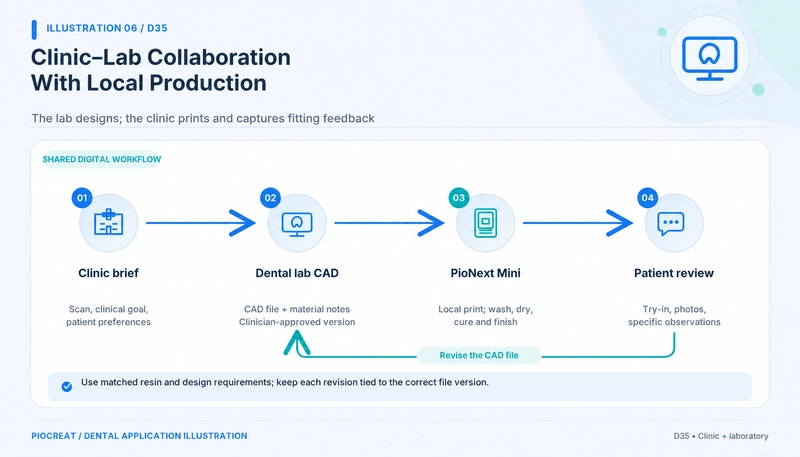
A practical shared workflow starts with a clinical brief and scan. The lab needs the anatomy and bite information relevant to the case, together with the intended object, appearance requirements and selected material. For an esthetic case, photographs and the patient's preferred tooth form make the design task more specific.
The lab returns the restoration or appliance file with the selected material and relevant design notes. The clinic prepares that file in PioNext BOX for PioNext Mini. If fitting leads to a revision, identifying the design version and the feature to change lets the lab update the geometry while the clinic retains its local production setup.
Before the first case, send the lab the chosen resin and its design requirements. For a temporary bridge, that includes the material's permitted span and connector requirements. For a splint, it includes the intended material and the fitting preferences the designer needs. The PioNext Mini resin parameter reference helps identify named material configurations for the discussion with our team and the resin manufacturer.
The local operator then prints, cleans and dries the object, completes the material-specific post-cure, and finishes it for the intended application. The clinic can show the result to the patient and return concrete observations to the laboratory for any design development.
Returning Manufacturing and Fitting Feedback
The strongest feedback combines a specific observation with a useful view of the patient or object. That gives the technician a clear feature to work on and keeps the revision connected to the patient's experience.
For example, a patient may prefer a shorter incisal edge after trying a mock-up. A photograph of the smile, a close view of the relevant tooth and a description of the preferred change give the lab a direct design brief. The revised file can then be manufactured locally for another comparison.
Other applications generate different kinds of feedback:
|
Chairside observation |
Useful information for the lab |
What the next version can address |
|
A mock-up appears too prominent from the side |
Profile photograph and the patient's comment about fullness |
The visible contour within the clinical plan |
|
A provisional's appearance needs refinement |
Smile photographs, the selected shade reference and the region to change |
Tooth form or characterization instructions |
|
A splint's fitting needs review |
The dentist's description of seating, retention or the relevant occlusal contact |
The corresponding appliance design feature |
|
A print is incomplete or damaged |
Photograph of the part, job preparation and material details |
A production review with the operator and supplier |
For a design revision, keep the change attached to the corresponding digital version. This allows the clinic to print the intended comparison and lets both teams see whether the revision addressed the original concern.
The patient benefits from a more visible response to feedback. Instead of describing a concern that will be reconsidered after a physical shipment, they can see how the proposed form changes through the digital design and a locally produced object.
A Collaboration Pilot for One Application
Choose a recurring service and compare two routes: the laboratory supplies the finished physical object, or the laboratory supplies dental CAD design and the clinic manufactures it with PioNext Mini. Use comparable cases and include the complete work required for delivery.
The expected advantages are practical:
- Less physical transport. Selected jobs move as design files, removing the shipping stage for those locally produced objects.
- Faster access to revisions. A revised geometry can enter the clinic's next production job, which is useful during mock-up or provisional development.
- A focused clinic investment. The practice adds local manufacture while continuing to purchase the lab's design expertise.
- Potentially lower fabrication cost. Part of the external manufacturing charge may be replaced with local materials and production work.
- Closer patient participation. The clinic can obtain comments on a physical preview and return them to the designer with photographs.
Use a complete cost comparison:
|
Cost or time component |
Finished object supplied by lab |
Lab design with local PioNext Mini production |
|
Design |
Included or charged within the lab service |
Agreed design and revision fee |
|
Fabrication and finishing |
Lab's production charge |
Resin, supports, cleaning, finishing and operator labor |
|
Physical delivery |
Shipping cost and transit time |
Local movement from production area to treatment room |
|
Equipment |
Primarily reflected in the lab fee |
Allocated printer, processing and maintenance cost |
|
Fitting |
Clinic fitting and adjustment time |
Clinic fitting and adjustment time |
The potential saving is the difference between those complete service costs. Ask for a separate lab design quotation and calculate the local production cost at the expected monthly volume. This makes the benefit specific to the practice rather than relying on a generic percentage saving.
Measure the time from scan to patient delivery, the number of collection visits and the turnaround of a representative revision. Those results show whether the partnership improves the service patients receive and whether the local production work is economically useful.
Talk with PioCreat about a joint PioNext Mini demonstration with your laboratory, built around one of the models, previews, provisionals or splints your practice regularly needs.