

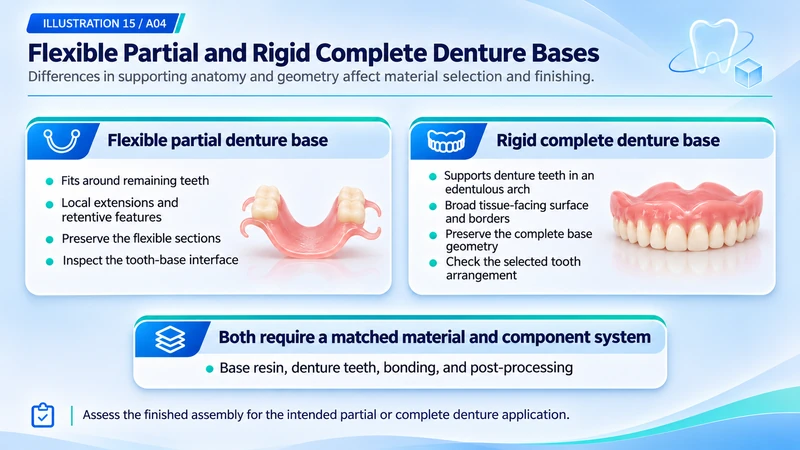
A flexible partial denture base fits around the patient’s remaining teeth. The lab needs to preserve the thin retentive sections, the contours that fit against supporting tissues, and the surfaces that hold the replacement teeth. A support removal mark on a thin arm needs different attention from a mark on the thicker body of the base.
3D printing flexible partial denture bases starts with a dental CAD design that defines those features. PioNext Ultra has a dedicated Flexible Denture Base Resin entry in its material parameter reference, giving the lab a specific profile for this application.
What Changes With a Flexible Partial Denture Base
A removable partial denture replaces selected missing teeth within an arch that retains natural teeth. Its retentive geometry must work around the remaining teeth while the base follows the supporting tissues. For an edentulous arch, see 3D-printed rigid complete denture bases for intaglio surfaces, borders, and assembly with denture teeth.
|
Comparison |
Flexible partial denture base |
Rigid complete denture base |
|
Remaining dentition |
Works around existing teeth |
Serves an edentulous arch |
|
Geometry to preserve |
Local base extensions, tooth-base interfaces, and designed retentive features |
Broad tissue-facing contours, borders, and tooth-base interfaces |
|
Finished-part assessment |
Seating around remaining teeth and the condition of retentive features |
Adaptation of the complete base and the assembled tooth setup |
Flexural modulus describes material stiffness in bending. Elongation at break describes the tensile strain reached at failure. These properties describe different aspects of material behavior. The finished retentive features also need to return to their intended shape during handling. Compare material data using equivalent test methods and processing conditions.
A narrow retentive arm and a broad section of the same resin respond differently because their cross sections differ. Removing a support mark can thin that arm further. Compare the finished contour and thickness with the design and evaluate those findings alongside the resin’s material properties.
What PioNext Ultra Provides for Flexible Bases
Our PioNext Ultra resin parameter reference lists Flexible Denture Base Resin at a 0.1 mm layer thickness, separately from Denture Base Resin. The flexible and rigid formulations have separate exposure and timing settings. In PioNext BOX, select the material profile corresponding to the base being produced.
Review the entire partial denture base in PioNext BOX, including the retentive arms and supports. Two bases with similar central sections may require different build areas because one has longer extensions. When arranging a batch in the same resin, allow space for each complete base and its supports.
Inspect where supports meet narrow retentive features and how those supports will be removed. Leave access for cleaning the tissue-facing surfaces and tooth-base interfaces without damaging the thin sections.
The Flexible Denture Base Resin material description identifies removable partial denture bases as its application and describes elongation and impact behavior. Those material characteristics should be considered together with the actual base geometry and the current processing instructions.
A comparison with injection molding should cover the entire printed-base process, including cleaning, drying, external post-curing, finishing, and tooth attachment. Also compare the adjustment and repair methods available for each material system.
Match the Teeth to the Flexible Denture Base
The tooth-base interface must accommodate the selected denture teeth and bonding method. Before manufacturing the base, identify how the teeth should reach their final seating positions and which surfaces form the bonding region.
A relatively rigid denture tooth sits within a base intended to flex. Inspect the thin sections beside the socket and their transition into the main base. Support removal and surface finishing should preserve these regions, because a locally thinned junction changes the structure surrounding the connection.
Use the specified bonding system with the surface condition and processing stage it requires. Establish which preparation is needed on the base and tooth surfaces, how the components are held in position during bonding, and how the joint is cured and finished. A defined assembly procedure helps the lab reproduce the joint across its partial denture designs.
Our PioNext Mini flexible-denture workflow illustrates tooth seating, bonding, and cleanup of the junction before curing the bonded joint. It shows how the components are assembled; PioNext Ultra requires the print settings and external post-curing procedure specified for its selected material combination.
What a Flexible Denture Base Sample Should Demonstrate
Evaluate the processed base with the denture teeth intended for production. Inspect its retentive features, tissue-facing surface, and tooth-base junction separately.
Retentive features: in the lab, compare the finished contours with the CAD design. Inspect narrow sections for incomplete printing, damage from support removal, or excessive thinning during finishing. At the fitting appointment, the dentist evaluates seating and retention around the patient's remaining teeth.
Base surfaces: inspect support removal sites, border smoothness, and tissue-facing contours. A polished outer surface should not conceal a rough junction or damaged fitting area. Where support finishing is extensive, include that labor in the production assessment.
Tooth-base junction during handling: inspect the junction after the flexing that occurs during normal handling. Look for separation, a change in tooth position, or damage beside the joint. Assess any change in relation to the local geometry, bonding method, and surface finish.
Two bases made from the same resin can differ locally if support removal leaves a notch on one narrow arm or finishing removes material beside a tooth seat. Compare those regions before changing the material profile across the whole batch.
Establish PioNext Ultra Flexible Denture Base Production
Base the production quote on the finished assembly. Include support removal around retentive features, preparation of the bonding surfaces, tooth positioning, and junction finishing. Track hands-on labor separately from printer time so the quote covers the assembled partial denture base.
Identify the cause of any rework. A notch left during support removal, an obstructed tooth socket, and a bonding problem require different corrections. Use those findings to refine the layout and assembly procedure for subsequent partial denture bases.
Identify the adjustment, rebonding, and repair methods supported by the chosen material system. A later request to replace one tooth involves the existing junction and the replacement tooth; damage to a retentive feature concerns a different part of the base. The supported repair method determines whether the lab can repair the existing assembly or needs to produce a new base.
Discuss your flexible partial denture base design with our team, including the selected denture teeth and the features that need to remain flexible. Ask about PioNext Ultra material settings and post-processing instructions for that tooth-base combination.